The Oddest but Coolest Writing Tool You Never Knew You Couldn’t Live Without
As a writer, I often find myself in conversation with other writers about our processes. We go on and on about how we work, what makes us tick, and that which allows our words to fly onto the page. But unlike other writers, I don’t particularly like answering the question because, like every creative project, the developmental process is a personal one.
Our writing processes are as unique as we are. They’re like fingerprints; therefore, what works for the goose may not—and likely won’t—work for the gander. But it’s always fun to notice how different we creatives are and what helps each of us actually create.
Our quirks are amusing, and I have one I am going to reveal. Please don’t judge.
I have a tool I believe many writers will benefit from and put to good use. It’s a tool that can be easily incorporated into anyone’s individual writing process, but it’s a weird one.
What is this oh-so-great writing tool?
A metronome.
What the heck is a metronome?
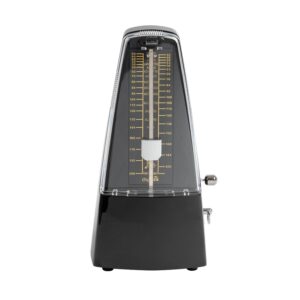
A metronome is that cool thing-a-ma-bob that usually sits on top of a piano to keep rhythm. The musically inclined have been using it for centuries, and the design hasn’t changed much.
The metronome is a stellar example of mechanical perfection—of beauty in simplicity—matched only by its uncanny ability to provide the service it is made for: tempo.
It looks a little something like this:
This post contains affiliate links. As an Amazon Associate, I earn from qualifying purchases. You can read our Affiliate Policy here.
Why a Metronome?
Go with me on this one; I promise you’ll see the light—err, hear the light.
Truth be told, I’ve used music as a writing tool for many years. The process goes as follows: several paragraphs into a new piece, I begin to sense an emotion flowing from the language. I then try to match that emotion—be it thrilling, sad, energetic, etc.—to a musical composition.
I use this technique heavily in the editing process as well. When I reread the piece while listening to the music, some words just don’t fit the flow. It could be that it has too many syllables, or the wrong pronunciation, or any number of ill-fitting qualities. But there’s always a different word that will fit perfectly, in time with the musical harmony, but also with my voice and overall message. For me, it’s a holy trinity. I hope I’m explaining myself correctly, but it’s like fitting a piece to a puzzle, and the music helps me do it.
I get goosebumps when I find that one beautiful, magnificent word.
When the writing is done, I read the entire piece while the chosen musical composition plays on loop. The piece is perfect when all the words read lyrically to the composition.
Each piece of writing becomes somehow poetic in that way, eliciting more goosebumps.
It may sound ridiculous now, but it wasn’t until a few years ago that I realized my writing has a beat, the same as musical compositions and other creative outlets.
Writing Has Soul
Writing has rhythm and pace.
A thriller tends to read quickly, the reader unable to flip through the pages fast enough, while a memoir proceeds somewhat slower, the narrator guiding you through their remembrances. A romance flows through different beats, beginning slower then building to a crescendo.
One day, plagued with a particularly challenging piece I was writing, its chosen musical accompaniment was not working at all. It was off, somehow, and throwing me off as well.
Then it dawned on me: I don’t necessarily write to music as much as I do to beat. Then it further dawned on me that if each piece has a soul, then each piece has a heartbeat; its own unique song that breathes life into it.
This realization stirred a memory from long ago: sitting at a piano in my 8th-grade music class, practicing scales.
My music teacher suggested I use “this”, pointing to a weird thing-a-ma-bob.
“What’s that?” I asked.
“A metronome. Here, this is how it works.” She then proceeded to set the weight to I-don’t-know-what, and off it went! TIC-TIC-TIC-TIC-TIC-TIC-TIC, it was marvelous. It was meditative. I was sucked into the rhythm.
Somewhere deep down, my soul connected with the repetitive pulse, and I no longer had problems with scales after that. However, I didn’t pursue music beyond that piano class, and as such, I’d completely forgotten about the handy little device until that memory sprang up out of nowhere.
The bright light of an idea danced in my head: I could set the metronome to the heartbeat of my writing piece, whatever feels right for the piece, adjusting as needed.
I knew I had to have a metronome in my life, and because these days I’m very much into white office furniture and matching supplies, I purchased this one:
Invigorated with a newfound toy, I wrote my absolute best piece ever! And although they’re not all gems, my writing has taken on new heights. I leveled up, as they say. Furthermore, I love using the metronome. And let’s face it, writing can be laborious, even for those of us who live and breathe it. Therefore, any writing tool that can assist the process—that can truly offer a better way to achieve a great product—and one you thoroughly enjoy using, is worth its weight in gold, no?
So, that’s it, the metronome—most commonly used in musical pursuits—is the oddest, but coolest writing tool you never knew you couldn’t live without!
This post includes affiliate links. I may earn a small commission at no extra cost to you. Thank you for your support.
Until next time,
Cynthia M. Hall
Writer • Editor • Creative Guide
Changing the World One Word at a Time